CreaSus: Three Years, One Final Act in Brussels
6th October 2026 The final act in Brussels On the 28th and 29th September 2026, WestBIC joined our CreaSus partners in Brussels for the project’s final
6th October 2026
The final act in Brussels
On the 28th and 29th September 2026, WestBIC joined our CreaSus partners in Brussels for the project’s final conference and our last partner meeting. Three years after the project began, it was a chance to share what we built, hear from the organisations who put it to the test, and look at what comes next for sustainability in the Cultural and Creative Sectors and Industries (CCSIs).
The conference, The Next Act for CCSIs: Driving Sustainable Practices for a Competitive and Resilient Sector, brought together cultural professionals, researchers, sector representatives and policymakers from across Europe.
CreaSus is co-funded by the European Union under the Creative Europe programme. WestBIC has worked alongside Fundación Banco Santander (Spain), the University of Bari (Italy), ENCATC (Belgium), Mosaic (Greece) and Zabala Innovation (Spain) since the project launched in October 2023.
Day 1: from vision to practice
Borja Baselga, General Director of Fundación Banco Santander, opened the conference with a clear message on competitiveness in the CCSIs. The discussion, he said, “is no longer about objectives, it’s now about implementation.” The focus now is long-term competitiveness across the whole sector.
That set the tone for the first session, From Vision to Practice: CreaSus Tools in Action, moderated by WestBIC’s own Alison McGonagle. Every panellist had piloted the CreaSus Self-Assessment Tool, and we were especially proud to welcome Niamh Ní Fhlatharta of Branar, one of Ireland’s leading theatre companies making work for children, based here in the West of Ireland. She was joined by Christina Ntaltagianni, Head of Human Development, Clio Muse Tours (Greece), Askhen Fixova, Project manager and Coordinator of the AEC Network of Green Officers, Association Européenne des Conservatoires, Académies de Musique et Musikhochschulen and Nuria Gallego, Head of Sustainability, Accessibility and Infrastructures, Teatro Real (Spain).

What the self-assessment revealed
Christina encouraged organisations to look deeper than the score itself. Practices her team treated as normal turned out to be a big part of their sustainability story; the tool made visible something they already knew but had never measured. Her key distinction was between having sustainable practices and having sustainable systems.
Askhen valued how the tool looks at sustainability through the lens of the triple transformation, addressing it as a whole. Sustainability is a journey, she said, and the tool is a valuable way of checking where you are on it.
Turning results into action
Niamh spoke about the practicalities of putting sustainability into practice at Branar. That started with measuring everything. She was candid about the realities of working with freelance teams and public funding models, and shared Branar’s goal of working towards a carbon budget. Having the data now gives them a benchmark to build on.
Sustainability as a business asset
Nuria described how Teatro Real made significant changes, including to its lighting, that saved money while reducing its impact (more examples are in the CreaSus business models report). Christina explained how her organisation moved from a funding conversation to an ESG conversation. The assessment gave them insights they now use beyond CreaSus when approaching private finance, strengthening how they present their organisation. It became a business asset.
Advice for organisations starting out
- Start small, but start now. Niamh advised looking at your team’s capacity and influence, and taking it on a bit at a time.
- Focus on what’s possible. Askhen stressed that action takes time and honesty matters. What we do may not save the planet, but small, persistent, consistent actions have an impact.
- Find out how sustainable you are. Christina’s advice was not to start by asking how sustainable you want to look. Be honest, be measurable and be selective.
In Nuria’s words, “Sustainability is in your hands.” And as Alison put it to close the session, “If you aren’t measuring it, you can’t work on it.”
Day 2 and our final partner meeting
Day 2 brought the conversation to the European Parliament, closing three years of work with a forward-looking Policy Roundtable on what is needed to advance sustainability across Europe’s cultural and creative sectors and industries.
Opening the session, MEP Marcos Ros Sempere congratulated CreaSus on the range of tools, resources and knowledge developed to support CCSIs on their sustainability journey. Gilles Pelayo also highlighted the project’s contribution, describing CreaSus as one of the most prominent Creative Europe projects in the portfolio addressing sustainability.
From there, the discussion looked ahead. Speakers explored how sustainability can be more firmly embedded in cultural policy, and how European funding and support frameworks can respond to the realities of small and micro-organisations. They also considered how the evidence and practical experience generated by projects like CreaSus can inform the sector’s next steps. The exchange brought together perspectives from European institutions, cultural organisations and sector experts, including Sir Paul J.R. Dujardin and Mariane Cosserat.
For WestBIC, that focus on small and micro-organisations felt especially relevant. It reflects exactly what we heard from the Irish CCSIs we worked with throughout the pilot.
Alongside the conference, the consortium met for the last time as a project team, where we discussed the final deliverable and future of CreaSus. It was a fitting way to close three years of collaboration.

Looking back on three years of CreaSus
When CreaSus began in October 2023, the question at its heart was simple to ask and hard to answer: how can sustainability become a real part of how cultural and creative organisations operate, rather than an add-on? Three years later, we have a set of practical answers, and a community of organisations using them.
In our 2024 update from the General Assembly in Bari, we wrote about the early work on the CreaSus Self-Assessment indicators, built on the EU EFRAG model but tailored to the realities of the CCSIs. Alison presented WestBIC’s approach to the business models the project would develop, with a focus on aligning strategy with the SDGs, market trends, digital transformation and cross-sector collaboration. At that stage the pilot was still ahead of us.
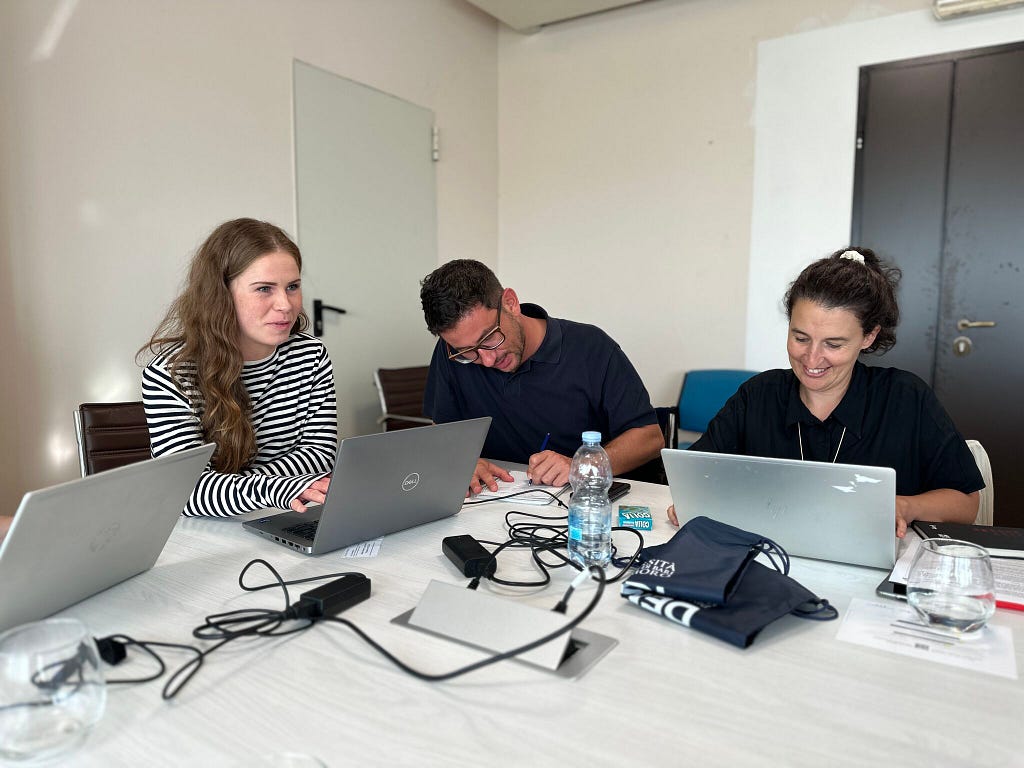
Sitting in Brussels this week, it was rewarding to hear pilot organisations describe how those same indicators and business models changed the way they work. Ideas that were on a whiteboard in Bari are now shaping carbon budgets, funding applications and conversations with private investors.
Working with Irish CCSIs
For WestBIC, the most rewarding part of CreaSus has been the chance to work closely with Irish creative and cultural organisations. We were lucky to work with a number of Irish CCSIs through the pilot, including Branar, [add other Irish organisations involved]. Each brought honesty about what is difficult: tight teams, freelance workforces, reliance on public funding and limited time. They also brought a real willingness to measure, test and change.
Seeing Niamh share Branar’s experience on a European stage was a proud moment for the team, and a reminder of the strength of the creative sector here in the West of Ireland.

CreaSus has also shaped how WestBIC thinks about our own work. As a Business Innovation Centre, we usually talk about sustainability in terms of startups and scaling companies. Working with the CCSIs showed us how much the creative sector has to teach about resilience, purpose and doing a lot with a little. We’ll carry that into the support we offer creative entrepreneurs across the region.
[Optional: add a short quote from Alison or the WestBIC team reflecting on the project.]
What’s next
The project may be closing, but the CreaSus tools remain available to cultural and creative organisations. The Self-Assessment Tool, funding toolkit and business model resources can all be found at creasus.eu.
A huge thank you to our consortium partners, to everyone who spoke and attended in Brussels, and above all to the Irish CCSIs who gave their time to the pilot.
If you’re a creative or cultural organisation interested in using the CreaSus resources, or would like to talk to WestBIC about building sustainability into your business model, contact Alison McGonagle at amcgonagle@westbic.ie.

CreaSus is co-funded by the European Union under the Creative Europe programme. Running from October 2023 to September 2026, it set out to guide and support CCSIs to make sustainability a key part of their operations and a competitive advantage, through a system of self-assessment indicators, a funding toolkit, business models, capacity-building activities and pilots in Spain, Ireland, Greece and Italy.